What are canker sores?
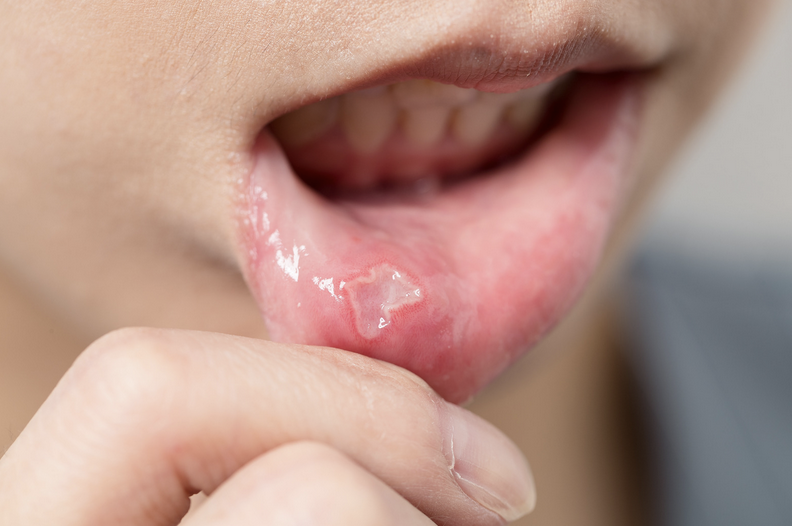
Canker sores (also called aphthous ulcers) are small, shallow ulcers that develop on the soft tissues in your mouth. They are white or yellow sores with a red border.
They occur inside the mouth and the location varies based on the specific type of sore. Finally, canker sores are NOT contagious!

How do canker sores start?
Tingling or burning sensations may occur a few hours before the sores appear. The area then turns red, swells up a little and then starts to hurt; white spot forms within 1-3 days. Afterwards, the pain decreases and the ulcer should disappear the next week.
There are 3 different type of canker sores:
- Minor (80%) – They are small (<1cm), oval shaped, and self-resolve within a few weeks. These are on loose tissues in the mouth (inner lips, inner cheeks or floor of mouth).
- Major (15%) – These are bigger (>1cm) and deeper than minor ulcers. They are very painful and may scar. They take months to heal. These can occur anywhere in your mouth.
- Herpetiform (<5%) – They are named “herpetiform” because they look like herpes sores but they are not caused by herpes virus. They look like “pinpoint” clusters of 10-100 and merge into 1 large ulcer. These heal within a few weeks, with possible scarring. Common areas include floor of the mouth or tip of the tongue.

What causes canker sores?
No one really knows what causes canker sores. The majority of these occur in healthy people with no issues and don’t require further testing.
Below is a list of medical causes that have been linked to those with severe pain or multiple recurrences:
- Immune-related disorders (Celiac, Chrons, Behcets, HIV/AIDs.)
- Medication side effects
- Hormones—menstruation can worsen ulcers
- Nutritional deficiencies – Vitamin B12, Vitamin D, folate, iron, zinc
- Genetic predisposition
If you have recurrent ulcers or if they are very painful then you should see your physician for possible medical causes.
What can trigger canker sores or make them worse?
1. Poor oral hygiene can lead to bacterial irritation of your soft tissues so keep up with brushing and flossing! Use a soft toothbrush and wax floss as gentle options near an ulcer. Toothpastes without Sodium Laryl Sulfate (SLS), such as OraNurse or Dr. Bob’s, can minimize irritation. SLS is a detergent in toothpastes that causes them to foam.

2. Tissue trauma can occur from rough brushing, sharp fillings, fractured teeth, or cheek biting. Braces can irritate the tissues so you may need ortho wax to cover the brackets.
3. Food sensitivities can worsen pain. Avoid foods that are acidic, spicy, oily, salty, or rough. Alcohol, caffeine, cheese, peanuts, almonds, and eggs have been found to worsen pain too. A well-rounded diet of whole foods can also prevent nutritional deficiencies, which can cause canker sores.

4. Stress can cause ulcers to appear during first day of school, final exam season, recent illnesses, or moments of emotional distress. Mindfulness, meditation therapy and breathing exercises are helpful tools in your back pocket to reduce stress.
What age do canker sores occur?
Canker sores tend occur more in in young people (teens-20s). They can occur in children as well. Its less common to get them after 40. Females are more likely than males to get them.
How do you diagnose canker sores?
The appearance, development and symptoms are often so typical that you can diagnose canker sores visually without any special tests. However, if ulcers last more than 2 weeks then medical testing may be recommended to rule out medical causes!
How do you treat canker sores?
Canker sores usually self-resolve so most don’t need treatment. Studies for canker sore treatments are lacking. What works for one person may not work for another.
Treatment is dependent on the severity of the pain, frequency of episodes, and the patient’s medical history and tolerance of medications.
It is important to minimize triggers (see above) in addition to treatments.
Parents should discuss options with their healthcare provider before giving any of these treatments to their child.
Below are examples of treatment options:
- OTC anti-inflammatory medications such as Ibuprofen or Naproxen
- Topical Anesthetics such as Orajel or Orabase that contain benzocaine
- Antibacterial rinses such as Chlorhexidine can prevent infections
- Pain-killing Mouth rinses such as Tantum or a Lidocaine rinse
- Topical Steroid creams (Triamcinolone)
- Steroid medications (prednisone)
- Physical treatment (Lasers, surgical removal, chemical cautery)
A physician referral may be required for possible bloodwork, biopsies, or other tests. They may treat underlying medical causes.
Are canker sores different than cold sores?
Yes! Cold sores and canker sores are different. Cold sores are fluid filled blisters that can break into ulcers. Tingling occurs before the blister appears. They eventually scab over and may scar.
Cold sores are caused by Herpes Simplex Virus. 90% of adults are infected with HSV but not all have cold sores.

New cold sores may have systemic symptoms such as sore throat, swallowing pain, fever, body aches, nausea among others. Cold sores can appear from a new infection or from a reactivated old infection.
The virus stays in our nerves and occasionally reactivates and traveling to the skin to cause cold sores. Cold sore diagnosis is visual but can be confirmed with a swab for HSV.
The location is also different than canker sores. Cold Sores occur on the outside of the mouth, usually around the lips.
Cold sores are contagious. They are contagious during first “tingling” sensation to when the scab falls off. The most contagious period is the first 24 hours. They can spread through sharing utensils, bottles, or kissing. Dentists may recommend delaying exams or treatment if an active cold sore is present.

There is no permanent cure for cold sores. However, some options include antivirals to promote healing. Home remedies include cold compresses and sunscreen (sun exposure may be a trigger). You can also use pain killers (ibuprofen or acetaminophen). Topical anesthetic gels like Orajel (avoid in kids under 2) can be used too.
When should I see a healthcare provider?
You should see a doctor or dentist if any of the following occur:
- Ulcer lasts longer than 2 weeks
- Systemic symptoms are present (fever, cough, congestion, swollen lymph nodes etc.)
- Ulcer is larger than 1 cm
- Ulcers occur multiple times a year
- Pain is unmanageable with over-the counter medications
- Interferes significantly with daily routines
It is possible the sore could be due to a viral cause or another type of pathology that may require further assessment.
The final word…
Canker sores (aka aphthous ulcers) are common. The majority are minor ulcers that self-resolve without treatment. There is no known explanation for their cause and treatment success varies per person. Parents can minimize triggers to reduce pain. Canker sores are different than cold sores, which are contagious! Parents should see a physician or dentist if they are concerned and further testing may be required.
References:
Clark, D. (2013). How do I manage a patient with aphthous ulcers?. J Can Dent Assoc;79:d48. https://jcda.ca/article/d48
Cold Sores. Cleveland Clinic. (2024). https://my.clevelandclinic.org/health/symptoms/cold-sores
Cleveland Clinic. (2025). What are canker sores?. https://my.clevelandclinic.org/health/diseases/10945-canker-sores
InformedHealth.org [Internet]. Cologne, Germany: Institute for Quality and Efficiency in Health Care (IQWiG); 2006-. Overview: Canker sores (mouth ulcers) [Updated 2022 Oct 17]. Available from: https://www.ncbi.nlm.nih.gov/books/NBK546250/
Mayo Foundation for Medical Education and Research. (2018). Canker sore. Mayo Clinic. https://www.mayoclinic.org/diseases-conditions/canker-sore/symptoms-causes/syc-20370615
McBride DR. Management of aphthous ulcers. Am Fam Physician. 2000 Jul 1;62(1):149-54, 160. PMID: 10905785.
Plewa MC, Chatterjee K. Recurrent Aphthous Stomatitis. [Updated 2023 Nov 13]. In: StatPearls [Internet]. Treasure Island (FL): StatPearls Publishing; 2025 Jan-. Available from: https://www.ncbi.nlm.nih.gov/books/NBK431059/
Tarakji B, Gazal G, Al-Maweri SA, Azzeghaiby SN, Alaizari N. Guideline for the diagnosis and treatment of recurrent aphthous stomatitis for dental practitioners. J Int Oral Health. 2015 May;7(5):74-80. PMID: 26028911; PMCID: PMC4441245.
The American Academy of Oral Medicine. (2007). Canker sores. https://www.aaom.com/index.php%3Foption=com_content&view=article&id=82:canker-sores&catid=22:patient-condition-information&Itemid=120
U.S. Department of Health and Human Services. (2024). Fever blisters & canker sores. National Institute of Dental and Craniofacial Research. https://www.nidcr.nih.gov/health-info/fever-blisters-canker-sores
Vigneswaran, N., Muller, S. Diagnosis of oral mucosal inflammatory and ulcerative diseases. Clin Dent Rev 4, 17 (2020). https://doi.org/10.1007/s41894-020-00076-w
Leave a Reply