What is an orthodontic pacifier?
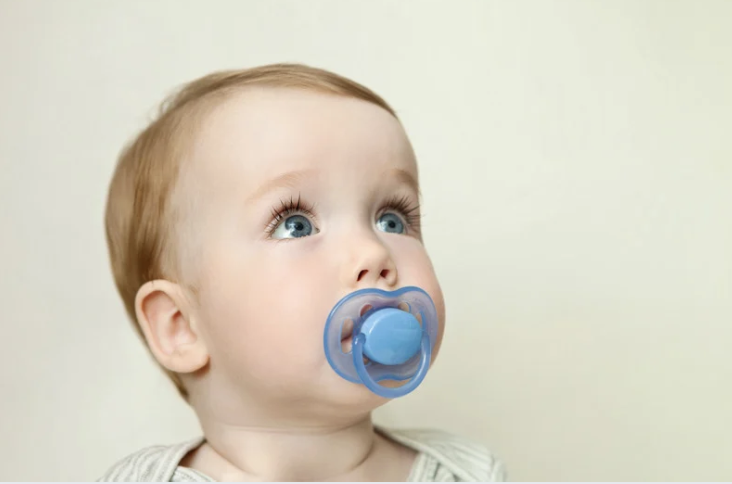
Orthodontic pacifiers are different than conventional pacifiers. They have a flatter nipple to mimic a human nipple.
Orthodontic pacifiers claim to have a more “natural” shape than regular pacifiers, thus reducing risk of bite changes like open bite and posterior cross-bites.
Checkout our first Dentopedia post on pacifiers to learn more about pacifiers and bite changes!

Are there any benefits to pacifiers?
Yes, pacifiers can prevent Sudden Infant Death Syndrome (SIDS) in the first year of life. Pacifiers can relieve pain during painful procedures. They can also calm your child when they are irritated or trying to rest.
Canadian Pediatric Society supports the use of pacifiers as a parental decision determined by the needs of their child.
Can orthodontic pacifiers change my child’s bite?
Yes they can change your child’s bite!
Studies show that regular pacifiers and orthodontic pacifiers have a similar risk of causing bite changes. They found that the shape of the pacifier was less important than the hours-of-use.
Using a pacifier (regardless of shape) for 4-6 hours/day was enough to cause bite changes. Also, using it later than 3 years old can result in the changes being more permanent.
The best way to avoid bite changes is to not use a pacifier at all.
My child needs a pacifier to sleep. How can I avoid bite changes from happening?
The main goal is to reduce the hours-of-use. You can try removing the pacifier when your child falls asleep and putting it away.
You don’t need to go cold turkey. Removing the pacifier can be done over 6-12 months depending on your child’s needs.
Avoid scolding or punishing tactics as your child may become more resistant to letting go of the pacifier.
Will my child need braces because of the bite changes?
Not necessarily. The bite usually self-corrects if pacifier use stops by 3 years old. The lips, tongue and cheek muscles act on the jaws/teeth to reposition the teeth/jaws over time.
There is a chance that orthodontics may be needed later in life. Your child should see a dentist for regular checkups in case the bite changes persist later.
The final word:
Orthodontic pacifiers have not been proven to be better than regular pacifiers.
The hours-of-use is more important than the specific shape of the pacifier when it comes to changing the bite. Using a pacifier (regardless of shape) more than 4-6 hours/day or later than 3 years old will increase the risk of bite changes.
Stopping early can lead to these changes self-correcting and less of a chance of braces in the future!
References:
American Academy of Pediatric Dentistry. Policy on pacifiers. The Reference Manual of Pediatric Dentistry. Chicago, IL: American Academy of Pediatric Dentistry; 2025:86-9.
Canadian Pediatric society. (2022, July). Pacifiers (soothers). Caring for kids. https://caringforkids.cps.ca/handouts/pregnancy-and-babies/pacifiers
Lima AA, Alves CM, Ribeiro CC, Pereira AL, da Silva AA, Silva LF, Thomaz EB. Effects of conventional and orthodontic pacifiers on the dental occlusion of children aged 24-36 months old. Int J Paediatr Dent. 2017 Mar;27(2):108-119. doi: 10.1111/ipd.12227. Epub 2016 Feb 9. PMID: 26856705.
Medeiros R, Ximenes M, Massignan C, Flores-Mir C, Vieira R, Porporatti AL, De Luca Canto G. Malocclusion prevention through the usage of an orthodontic pacifier compared to a conventional pacifier: a systematic review. Eur Arch Paediatr Dent. 2018 Oct;19(5):287-295. doi: 10.1007/s40368-018-0359-3. Epub 2018 Jul 27. PMID: 30054865.
Recommendations for the use of pacifiers. Paediatr Child Health. 2003 Oct;8(8):515-28. doi: 10.1093/pch/8.8.515. PMID: 20019941; PMCID: PMC2791559.
Leave a Reply