Why is brushing so important to reduce cavities?
Cavities are mainly caused by 2 factors: 1) Sugar and 2) Bacteria (plaque). The bacteria eat sugar from our food and release acid on our teeth. This acid causes our teeth to breakdown into cavities over time.

Brushing prevents cavities by mechanically removing bacteria, sugar and acid.
Fluoride toothpaste hardens the teeth and makes them resistant to acid breakdown.
Should I clean my child’s mouth before they have teeth?
Yes you should! You can gently wipe their mouth with a damp washcloth or gauze in the morning after the first feeding and right before bed. You can position your child by cradling them in your arm. Don’t forget to wash your hands before cleaning their mouth!

Mouth cleaning removes bacteria and sugar which reduces bad breath. This cleaning habit also reduces risk of cavities once the teeth begin to erupt.
Using a washcloth or gauze can make transitioning to a toothbrush easier. Your child will be used to having their mouth cleaned with a device/item thus will be less fussy/fearful with a toothbrush.
You do not need toothpaste at this stage. The toothpaste sensation may be upsetting for your child. There are also no teeth so fluoride cannot prevent any cavities at this stage!
When baby teeth erupt, start using a toothbrush!
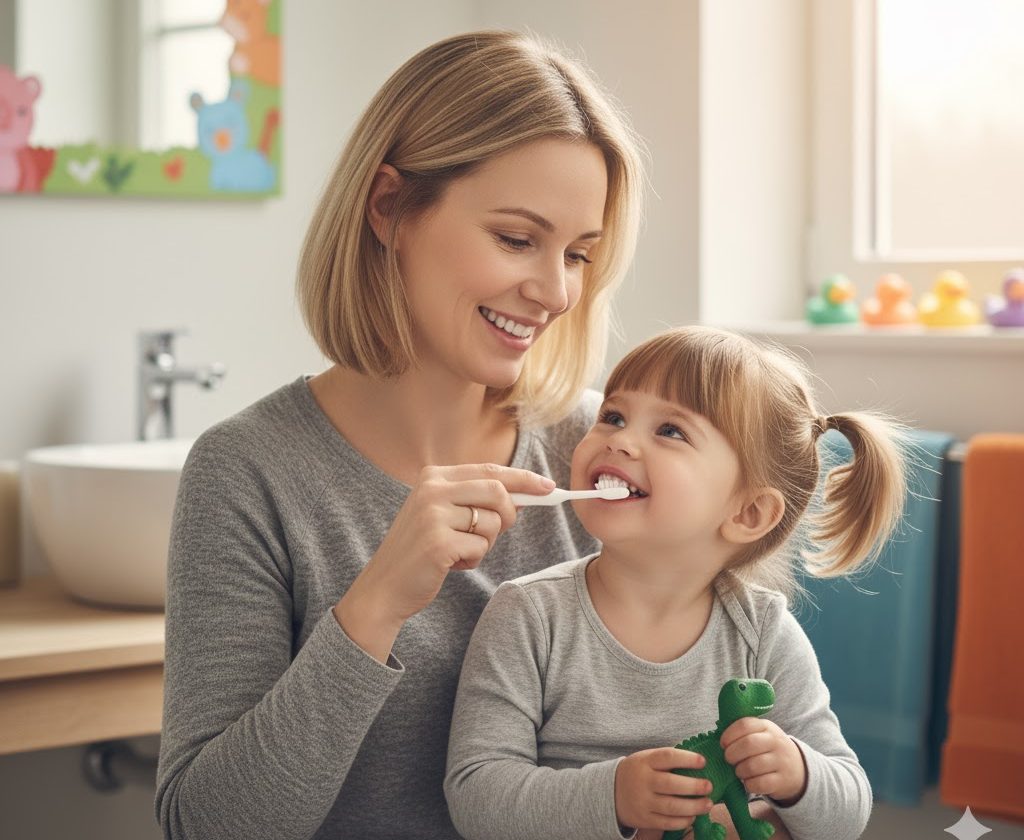
Once teeth erupt, parents can use a soft toothbrush with toothpaste (smear amount) twice a day.
Soft brushes are ideal as they cause least amount of gum trauma and have better cleaning between teeth than hard-bristle brushes.
How long should I brush my child’s teeth for?
Try to brush for 1 minute! Most plaque is removed after 1 minute so more than that has minimal benefits. You can increase to 2 minutes when they’re adult teeth erupt.
How many times should I brush my child’s teeth?
Twice a day! You should do it once in the morning and once before bed (after their last meal). Brushing less than twice a day has been associated with increased risk of cavities in children.
Whats the best way to move the toothbrush against the teeth?
Horizontal brushing motion is better than other techniques (circular, sweeping away from the gums).

There are 3 main surfaces to the teeth: the biting surface, cheek-facing surface and tongue-facing surface. Make sure you contact the bristles against all 3 surfaces.

Common mistakes with toothbrushing include: missing surfaces, brushing too fast, not enough pressure on the teeth and letting your child brush on their own.
When can my child start brushing by themself?
Parents should be brushing until their child is 6 years old. If your dentist notes plaque is on their teeth at 6 years, then parents should keep helping them brush. There is nothing wrong with supporting your child’s brushing later than 6 years old.
Children like to exercise independence as they get older. Parents can allow their child to brush on their own but should do it for them 1 more time afterwards. Most kids under 6 have not developed the dexterity and thoroughness to touch all surfaces of the teeth
When do we replace a toothbrush?
You can replace your toothbrush when the bristles appear severely worn and frayed. This can be around every 3-4 months. A toothbrush with a few frayed ends doesn’t need to be replaced immediately as it is sti;l effective to remove plaque.
Be aware that your brush will wear more quickly if your child frequently chews on the bristles.

When do we introduce toothpaste?
You should use a smear when the first tooth erupts until 3 years old and a pea-sized amount between 3-6 years old. Fluoride toothpaste is safe and beneficial! Checkout our fluoride toothpaste post for more info!

When do we start flossing?
Flossing can start when the teeth are touching together. Not every child has their teeth touching together so not every child needs to floss immediately. Flossing once daily is enough to prevent cavities in kids with teeth touching together.
Flossing removes food and bacteria between the teeth.
If there is space between the teeth, then flossing is not necessary as food. Teeth with spacing are less likely to have food caught between the teeth.
Floss picks are often easier to use on your child as you don’t have to put your finger in their mouth. You also don’t have to wrap the floss around your finger and put your finger in their mouth.

There are different materials: waxed vs un-waxed, thin vs thick, nylon vs Teflon. These types all work the same and one is not better at preventing cavities than the other.
Water picks are not mandatory to purchase for children. Water picks may be more aggravating due to the water spray. These products may be introduced during the teenage years, if preferred.
Does my child need an electric toothbrush?
No they do not! A manual brush can remove plaque and prevent cavities the same as an electric toothbrush.
Electric toothbrushes can make brushing more interactive with lights, timers and fun designs. These can improve brushing by making it more fun and engaging.
Electric toothbrushes are a good option if your child enjoys them more than a manual toothbrush.
My child has special needs and I have difficulty brushing their teeth. Do you have any options?
Kids with special needs may benefit from extra tools to help with their brushing. Below are a few options that parents may find useful! These products may be helpful even if your child does not have special needs. Click on the pictures below for a link to some available products.
Any products or brands shown are for educational purposes only. We are not affiliated with, sponsored by, or endorsed by any brand or manufacturer.
3-sided toothbrush
3-sided toothbrushes minimize rotations by allowing wrap-around of the brush over the teeth. This allows parents to be more efficient with their brushing and less chance of leaving plaque behind than a regular manual toothbrush! There a lot of options available on Amazon.


Unflavored Toothpaste
Toothpastes without flavors may be less aggravating to your child. Look for toothpastes without Sodium Lauryl Sulfate (SLS). SLS is the ingredient that causes foaming which can also be unpleasant for some kids. Don’t forget to make sure there is fluoride in the toothpaste. FYI Dr. Bob’s is only available in USA but Oranurse is available in Canada on Amazon.


Toothbrush Ergonomic Grips
Ergonomic grips are available so your brush is easier to hold. These may be more helpful when your child is brushing on their own after 6 years old. These can also be used for other items like kitchen utensils and hair combs.


Mouth Supports
Mouth blocks can help keep your child’s mouth open if they are closing their mouth while brushing. Foam blocks can be chewed through as they are soft. Also, they are expensive as they are generally used in dental offices but some websites offer them for home-use.

My child does not sit still and will not open their mouth for me. How do I brush their teeth?
Parents often ask me how to position their child if the child is not cooperating. There are a few recommendations below based on some textbooks.
Benefits of these positions: saves parents from back pain, better visibility of the mouth and easier access of the toothbrush!
2 Adults: knee-to-knee position
You can have 1 adult holding your child and the other holding their hands. The adult at the head brushes the teeth and the adult at the legs holds the child’s hands. The child’s legs can be wrapped around the waist of the non-brushing adult.
This can be done on the floor or between 2 chairs as shown below.


Single Adult Position
The parent can sit on the floor with their legs stretched out in front and child is positioned between their legs. The child’s head is between the thighs of the parent. If your child is resistant, then you can put your legs on top of their arms and legs.
This position can be a bit awkward but it will allow you to brush your child’s teeth if they are resistant to oral hygiene..

Below is a cradling position that can be done if your child lets you look in their mouth without resisting. You can do this while on a chair/couch or sitting on the floor as shown below.

The final word…
Brushing your child’s teeth can be a frustrating task in the mornings. Thankfully, there are various tricks, products and positions that can help ease the hassle. Parents should feel comfortable asking their dentist or dental hygienist to provide tips specific to their child. Don’t forget brushing is just one part of a broader approach to preventing cavities along with diet, fluoride and regular dental visits.
References:
American Academy of Pediatric Dentistry. Policy on Early Childhood Caries (ECC): Consequences
and Preventive Strategies. The Reference Manual of Pediatric Dentistry; Chicago, Ill.: American Academy of Pediatric Dentistry; 2025: (https://www.aapd.org/globalassets/media/policies_guidelines/p_eccconsequences.pdf)
Flossing & brushing. Canadian Dental Association. (N.D.). https://www.cda-adc.ca/en/oral_health/cfyt/dental_care/flossing_brushing.asp
Asadoorian J. CDHA Position Paper on Tooth Brushing. CJDH. 2006; 40(5): 232-248.
Dean, J. A., Jones, J. E., Sanders, B., Walker Vinson, L. A., & Yepes, J. (2022). Chapter 8: Mechanical and Chemotherapeutic Home Oral Hygiene. In McDonald and Avery’s Dentistry for the Child and Adolescent (11th ed.). essay, Elsevier.
Nowak, A. J., Christensen, J. R., Marby, T., Townsend, J., & Wells, M. (2019). Chapter 15: Prevention of Dental Disease: Conception to Age Three. In Pediatric Dentistry: Infancy Through Adolescence. (6th ed.,). Elsvier.
Muller-Bolla M, Courson F. Toothbrushing methods to use in children: a systematic review. Oral Health Prev Dent. 2013;11(4):341-7. doi: 10.3290/j.ohpd.a30602. PMID: 24046823.
Leave a Reply